Project Description
The project supports DBN in expanding access to long-term finance for micro, small and medium enterprises in Nigeria, with a focus on women-owned businesses and smaller agricultural enterprises.
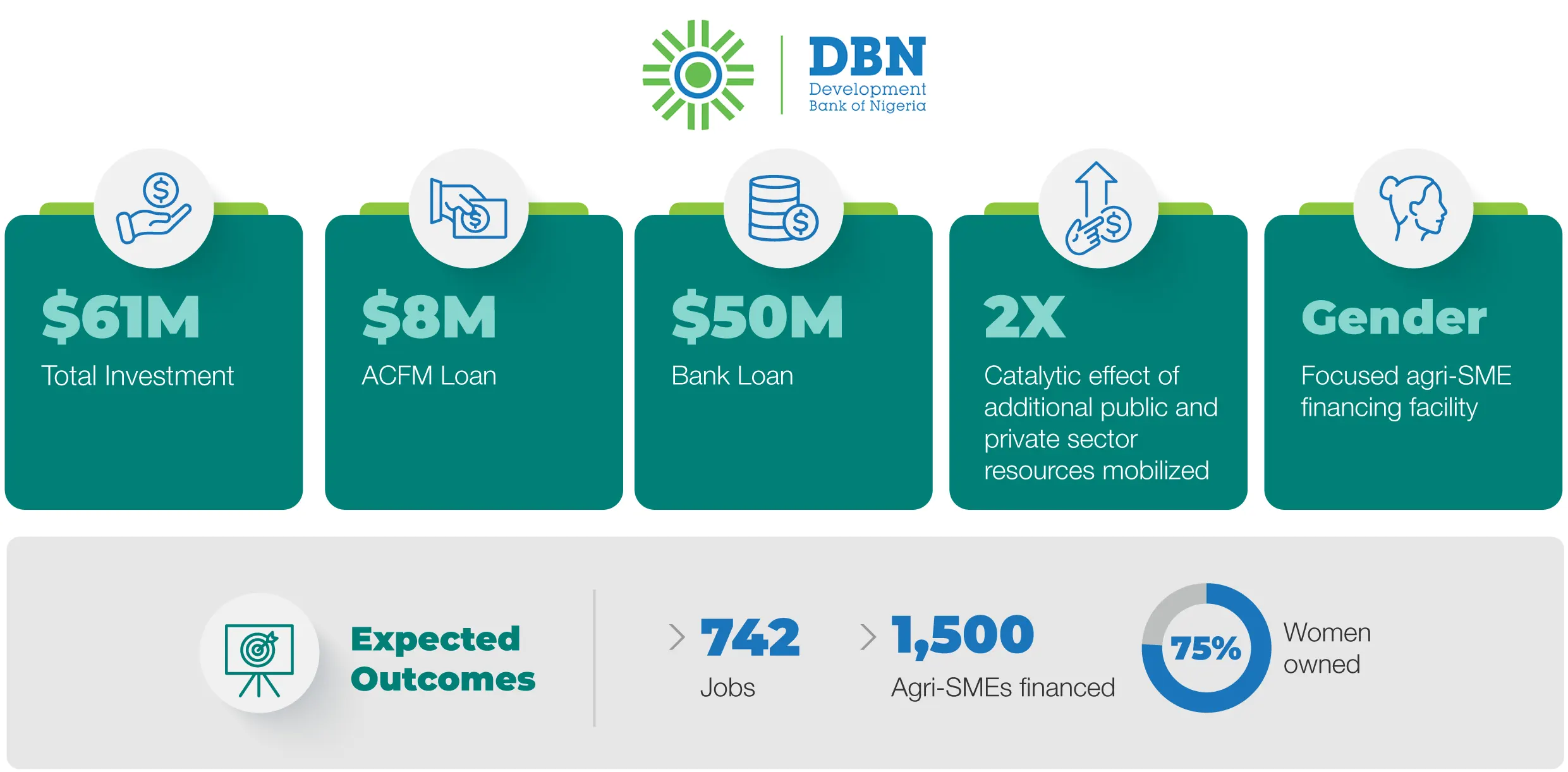
The USD 61 million financing package combines the Bank resources with concessional financing from ACFM and a performance-based grant from AFAWA. The Bank's facility will support DBN's broader women-owned MSME portfolio across sectors, while ACFM financing will be ring-fenced for agri-SMEs, with the majority directed to women-owned enterprises in agriculture.
The project addresses persistent financing constraints faced by women entrepreneurs and agricultural businesses in Nigeria. Access to credit remains especially constrained for women — only about 6% have access to bank-intermediated credit, compared to 23% of men. ACFM funding will target agri-SMEs — a segment DBN has historically approached cautiously due to perceived risk — while the AfDB facility will support women-owned MSMEs more broadly across sectors, including agriculture.
Through this operation, DBN will offer longer-term, more affordable financing, expand its agri-SME lending capacity, and strengthen its ability to reach women-owned enterprises at the base of the market. DBN has also committed USD 8 million of its own capital to match ACFM's contribution toward agri-SMEs, with concessional benefits passed directly to end beneficiaries.
Timeline
- 8 years
Geographic reach
- Nigeria
Sector
- Multi-sector, c.39% of the financing (USD 24 million) to Agri-SMEs
Project Objectives
- Access to Finance for women-led agri-enterprises: ACFM's support will help DBN build a dedicated portfolio for agri-SMEs, with priority given to women-owned enterprises, improving their access to finance while expanding Nigeria's agricultural value chains.
- Creating Markets: DBN's lending has traditionally focused on lower-risk sectors such as trade, manufacturing and services, largely avoiding agri-SMEs due to perceived risks like climate variability, price volatility, and informality. ACFM demonstrates that concessional, blended capital can be structured to make lending to this segment commercially viable for DBN and its network of Tier II/III participating financial institutions.
- Concessionality to ACFM target beneficiaries: All concessional benefits are passed to agri-SME borrowers rather than retained by DBN. ACFM's fixed rate of 0.8% allows DBN to absorb the cost of the mandatory FX swap with the Central Bank of Nigeria, keeping lending affordable. Due diligence confirmed 0.8% as the minimum rate required to make the transaction bankable and unlock DBN's own resources sustainably.
Expected Outcomes
- 1,500 agri-SMEs to receive financing through the facility (75%) women-owned.
- 742 additional jobs created via supported agri-SME.
- 750 agri-SMEs adopting or improving practices that better align with the 2X Challenge gender-lens investment criteria.
- 450 agri-SMEs strengthening their resilience to climate-related risks.
- 1x of private sector funds to be mobilized towards the ACFM target beneficiaries.