It would be an understatement to say how rewarding it felt to return to Kigali, Rwanda to attend the 2022 African Green Revolution Forum (AGRF) – live and in-person. After two years of being held virtually, Africa’s largest agricultural event roared back this year with an attendance of an estimated 2,400 in-person participants. Kudos to the Government of Rwanda and the AGRF Secretariat.
There is an undeniable energy from face-to-face events. It can be such a powerful tool to seed ideas, cement collaborations and revitalize conversations with a renewed sense of urgency, especially in the face of new and emerging threats facing agriculture, and in particular agricultural small and-medium enterprises (agri-SMEs) in Africa that are increasingly battered by climate change, the protracted economic fallout of the Covid-19 pandemic, and most recently the effects of the Russia-Ukraine crisis.
Over the five days, there was a recurring theme around the high risk of financing agri-SMEs. This topic kept emerging in formal talks which extended into the corridors, and at times well into the night. Underlying many of these conversations, I sensed an encouraging recognition and awakening among a range of central banks, financial institutions, insurance companies, capital providers, development finance institutions, impact funds, but most importantly, governments, to critically examine the existing agricultural credit structures to tackle the challenges proactively and systematically, rather than reactively responding to every new shock.
The common thread throughout the robust debate on the ‘risk-return dilemma’ was the need to leverage public resources within a revised policy framework to de-risk agri-SMEs financing. But also, to change the lens with which we evaluate agricultural risks, moving the needle from talks on risks, to discussions on resilience.
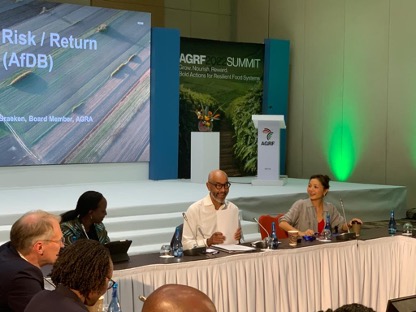
It was encouraging to listen to the dialogue around the need for blended finance, which is increasingly becoming more sophisticated, especially on the targeted use of public funds to de-risk agricultural financing, enhancing support to make SMEs more bankable, and collaborating with capital providers to make banks more ‘agriculture-friendly’.
For several decades, there has been a travelling narrative that investing in agriculture on the continent is riskier compared to other sectors. This may still be the case if we do not consider all the efforts and instruments used to de-risk agricultural lending, the emerging digital innovations reducing the transactional costs needed to service financing in the space, along with systematic value-chain solutions, that make agricultural enterprise more profitable.
However, in this new context of rapid development in the sector, which has witnessed a steep increase in venture capital investments and private sector appetite, we should revisit the methodologies by which risk is assessed and applied to the provision of capital. A comprehensive revisionary exercise on risk and credit worthiness of the sector undertaken in partnership with the relevant authorities assessing credit risk and applying related prudential limits would be critical.
Armed with fresh data, we can then systematically disentangle ‘real’ risk from perceived risks, and proactively target ‘real’ risks by bringing to bear a range of risk-mitigating innovations and policies that would not only make the food systems more resilient, but also uncover the huge opportunity for commercial returns and development dividends that exist.
In parallel, we should continue to push forward with some of the innovative thinking already underway to accelerate financing to agri-SMEs. For example, through an incredibly collaborative process with a wide range of experts and practitioners at the 2021 UN Food Systems Summit, three core pillars of any catalytic financing response to de-risking agri-SMEs have already been identified. These include concessionary capital, technical assistance, and impact mainstreaming.
Taking on board these insights, the Bank announced at a session of the AGRF Agribusiness Dealroom, the operationalization of the Agri-food SME Catalytic Financing Mechanism Special Fund which integrates these key features.
With an initial contribution of approximately $80 million from Canada, the Facility includes a mechanism that facilitates the provision of concessional debt and subordinated debt for financial intermediaries to de-risk and mobilise capital flows towards agri-food SMEs. In addition, the unique Facility emphasises technical assistance to incentivise and equip financial intermediaries keen to invest in the agri-SME space.
The technical assistance would support agri-SMEs to upskill with technologies, capacity and infrastructure that make their enterprises more resilient and commercially viable. And finally, a central pillar of the Agri-food SME Catalytic Financing Mechanism Special Fund is impact mainstreaming, targeting concessions to gender-oriented and climate-smart SMEs and emphasizing the tracking and performance of related impact metrics.
In many ways, this year’s AGRF provided a much-needed opportunity to meet with potential investors and investees, but also, to personally have a deeper engagement with many of our partners, whose contributions proved critical in helping us think critically about de-risking financing to agri-SMEs.
The collaborations developed are what is needed to advance these ideas into concrete interventions to transform food systems across Africa.